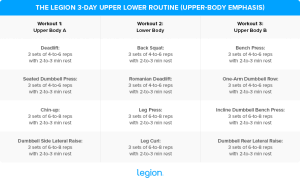

On the other hand, with upper body lower body split you can train one muscle group more than once a week, that greatly accelerate the muscle hypertrophy. Similar to your triceps, all the pulling movements in the upper body workouts will work your biceps. However, none of the exercises hits your biceps quite as well as the classic barbell curl. The upper/lower split is great for building muscle and gaining strength. There are numerous upper/lower training programs to choose from that apply progressive overload so you can maximize your results.
Switching Between Splits
The upper/lower split is a time-tested and scientifically-validated method for building muscle and strength. Its structure allows for a perfect blend of frequency and volume, which enables consistent progress without overtaxing your body. By prioritizing compound lifts, managing your recovery, and applying progressive overload, you can leverage this split to achieve significant results. The choice depends on your training experience, schedule, and personal preference. Beginners often start with full-body workouts, while intermediate and advanced lifters may prefer splits to manage higher volume.
The Purpose and Effectiveness of Upper Lower Splits
He’s a certified conditioning coach with a degree in design from York University in Toronto, Canada. He’s personally gained 70 pounds and has over a decade of experience helping over 10,000 skinny people bulk up. That said, improving performance should go hand in hand with proper form. As mentioned above, standardizing as many things about your training as possible makes it easier to notice improvements. There isn’t a trick to fix this; it comes down to pushing yourself hard on each set and logging your RPE. With Hevy, you can log RPE on each set and easily track your effort when reviewing your performance.
- It builds all pushing muscles in addition to being a very convenient exercise that requires no equipment.
- For beginners, a well-rounded full-body workout routine can provide a solid foundation and overall muscle development.
- That’s in contrast to isolation exercises, which generally focus on one muscle group.
- In most cases, you’re better off with longer rest periods between sets, rather than not getting enough.
- As a result, running has a much greater potential for impeding recovery and slowing muscle growth.
- For reference, exercises like leg curls will fall into this category since they are hamstring focused even through they don’t act on the hips.
Day Upper Lower Split for Strength & Hypertrophy w/PDF
It’s well balanced, can be adjusted for so many different schedules (2, 3, 4, or 5 workouts per week), and it works extremely well for building muscle, losing fat, gaining strength, and more. However, research suggests that you don’t need to train to failure to see gains in strength and muscle mass.4 5 Advanced bodybuilders might benefit from going to failure now and then. As a beginner or intermediate lifter, and when following StrengthLog’s 3-Day Bodybuilding Split, we suggest you terminate most of your sets a rep or two before failure. The only thing to keep in mind is to schedule at least one rest day between training days two and three. Both involve lower-body training, and you want to give your muscles a chance to recover from your workouts.

Lower Body Workout
This article only covers the 5/3/1 x 365 strength upper/lower workout program, where you train four days per week. You want to hit each muscle group at least twice every seven days, which you can do with both a full-body workout routine and an upper/lower split. As you focus on more than one muscle or muscle group per session, make sure you are still giving your muscles time to recover.

Anatoly Powerlifter Workout Routine & The Untold Story of Vladimir Shmondenko
It’s particularly useful for beginners who are laying a solid foundation, or for individuals with three dedicated training days per week. However, if your goal is rapid muscle hypertrophy or skill-specific training (e.g. powerlifting), a different split with more targeted volume may be a better option. An upper/lower split is typically better if you want to train two or four times per week, whereas push/pull/legs works well on a 3- and 6-day frequency. The upper/lower/full-body split is ideal if you want to train each muscle twice per week and work out 3 days a week. Feel free to decide the length of your inter-set rest periods to fit your needs and time frame.
It Accumulates More Total Volume
This simple double progression method can work well for most exercises, and will produce decent gains in muscle mass over several months, just as long as you stay consistent and work hard. That’s because the training you’re doing is a challenge your body has already adapted to. Don’t try to save time by cutting your rest periods short and racing from one exercise to the next. The hypertrophy stimulus generated by a given workout will be that much greater if you get a decent amount of rest between each set before tackling the next one. However, the days you train aren’t set in stone, and you can move things around from one week to the next depending on your schedule. By now, I hope you have a good idea of which type of training program suits your goals and circumstances better.
As far as rest between sets goes, you should rest for as long as you need so that you can do your prescribed repetitions on each set (2). For example, if you do ten reps on set one, you should get at least eight on the last. If you can’t, you’re either training too close to failure or not resting long enough. Without enough rest from one set to the other, you won’t be able to do as many reps. And it’s this reduction in volume load which has the knock on effect of reducing the stimulus for growth [11].
Incline Dumbbell Press
If you can commit to four days a week, the upper/lower split is a brilliant way to ramp up your training volume without having to live at the gym. This approach lets you hit every muscle group twice a week—a sweet spot for muscle growth—while allowing for more focused work than a full-body routine. On an upper/lower split with four training days, you might do 6 to 10 sets for chest on each upper day, totaling 12 to 20 for the week. On a body part split, you’d do all 12 to 20 sets in a single chest session. Both approaches can work, but spreading the volume across two sessions typically means better performance on each set because you’re less fatigued. The most aggressive version runs the cycle twice in a week for six training days.
Your rate of adaptation drops off, it becomes harder and harder to get your body to change. It takes a serious stimulus to keep growing a muscle, and you just can’t give it the stimulus it needs if you’re training the same muscles every time you train, and you aren’t giving it enough volume. By training everything every time you train, all you have to worry about is showing up consistently and putting in the work, and the program will take care of the rest. Now you can train whatever days you want each week without worrying about getting everything done.
Beginners will often see impressive results lifting weights three times a week, as their muscles can be made to grow with a relatively small amount of training. Training splits with less frequency may be good for a client who is a beginner or has limited time. A higher training frequency can help them achieve maximum muscle gain. As in all areas of training, split-workout strategies aren’t one size fits all. An important paper on training frequency and hypertrophy analyzed 140 studies and determined that splits may unimeal video review need to be tweaked a little bit for beginners and more advanced athletes and lifters (2). Unlike a “bro split” where you might have a dedicated day for chest or arms, an upper/lower split provides less session-specific volume for smaller muscle groups.
One limitation of full-body workouts is the need for a well-designed training program that effectively targets all major muscle groups. Without proper exercise selection and progression, full-body workouts may not provide sufficient stimulus for muscle growth and strength gains. Additionally, full-body workouts may not be the best choice for individuals with specific goals, such as targeting weak points or improving specific lifts.
High Frequency & Volume: The Perfect Mix
The workout splits just discussed are likely superior to the bro-split for a variety of reasons. The next section of this article will discuss these reasons and layout why you will likely want to utilize one of these routines instead of the bro split. Your body absolutely needs those days off to rebuild your muscles and prepare for the next workout. Not giving the body sufficient time to do this is guaranteed to result in decreased performance and overall results. Certain workout splits will be better suited to you than others depending on your lifting experience, how often you can or are willing to train, and your personal preferences.
Upper Body Workout 2
This type of workout routine is popular for strength training and muscle building, especially among intermediate lifters. It is designed to provide a balanced approach to muscle training by focusing on upper body workouts on certain days and lower body workouts on others. Incorporating compound movements and exercises helps ensure a full body workout while also providing enough time for recovery and growth. This approach effectively structures a full-body workout program with ample time for recovery and muscle growth. Consistent training within this split routine yields good progress in strength and muscle building, making it a versatile and efficient routine.